
Cyclic sighing takes five minutes, asks nothing of you but your own breath, and in a randomized study it outperformed the same five minutes of mindfulness meditation for both mood and stress arousal.
No app. No subscription. No cushion on the floor.
So if you have ever sat with your eyes closed while your to-do list got louder instead of quieter, the problem was never your discipline. Meditation is simply one more thing that can feel like failure.
Here is the part nobody connects for you. The pressure you keep pushing through does more than leave you tense and tired. It convinces your brain that you are starving, so your body hoards belly fat and dims your energy on purpose.
Ask Dr. Gala: Your Wellness Wisdom Starts Here
Can five minutes of breathing really calm your stress faster than meditation?
Yes. A 2023 randomized controlled trial out of Stanford, run by the labs of Dr. Andrew Huberman and Dr. David Spiegel, puts real numbers behind it. Published in Cell Reports Medicine, the month-long study had people practice a short daily breathing pattern called cyclic sighing: two stacked inhales through the nose, then one long, slow exhale through the mouth. Compared against a matched dose of mindfulness meditation, the breathing group came out ahead on both measures tracked, mood and physiological arousal, including a slower resting breathing rate. That long exhale is doing the work. It pulls on the vagus nerve and tells your nervous system the danger has passed. Meditation still earns its place for a longer stretch of calm, but minute for minute, this gets you there faster.
Why Does Chronic Stress Feel So Different in Midlife?
Wiring explains more here than willpower does. Researchers call the situation an evolutionary mismatch.
Short bursts of danger are what your nervous system was engineered to survive. Escape the threat, then rest, then recover. What modern life hands you instead is a threat with no off switch. Deadlines. Caregiving. Money. A phone buzzing on the counter at ten at night. Every one of those registers as danger to a survival system built thousands of years ago, and the all clear signal never arrives.
That constant load has a name. Chronic activation of your stress axis, the HPA axis, which leaves the whole system stuck in overdrive.
Chronic stress rarely announces itself as stress. It shows up as fatigue that sleep does not fix, brain fog that makes small decisions feel heavy, and a waistline that will not move no matter how carefully you eat. Years in survival mode leave marks like these, and most women read them as aging rather than as signals.
How Does Your Body Turn Threat Into Stored Fat?

The frustrating part is the logic sitting underneath it. A body that reads danger as permanent also reads supplies as short. Constant threat and expected famine register as the same emergency.
Your hypothalamus runs metabolism from a small control center in the brain, and famine gives it exactly one job. It performs that job perfectly here. Metabolism slows. Fat goes into storage, most of it around your middle.
Smaller portions and longer workouts can leave you feeling like your own body has taken the opposing side. Biologically, it has. Protection is the whole point, and your body is very good at it.
Clear thinking suffers under the same activation. No amount of effort will reason you out of brain fog while alarm bells are still ringing underneath. Safety has to register in the body first. Mental sharpness returns on the other side of that, which is why calming the body is where any real progress begins.
Why Does the Anger Arrive Out of Nowhere?
There is another side of midlife pressure that gets far less airtime. The sudden anger. The resentment. The reactivity that seems to come from nowhere and leaves you apologizing an hour later.
If you have been snapping at your partner, losing patience over small things, or feeling rage that seems bigger than the moment deserves, you are not a bad person, and you are not losing your mind.
Shifting hormones can thin the protective neurochemical buffer that once helped you absorb pressure without much effort. Everyday friction then lands harder than it used to, and the same conversation you would have shrugged off at thirty-five now leaves you rattled.
The anger has a physical cause, and a physical cause responds to physical care. Calm the system underneath and the fuse gets longer on its own.
How Do You Actually Practice Cyclic Sighing?
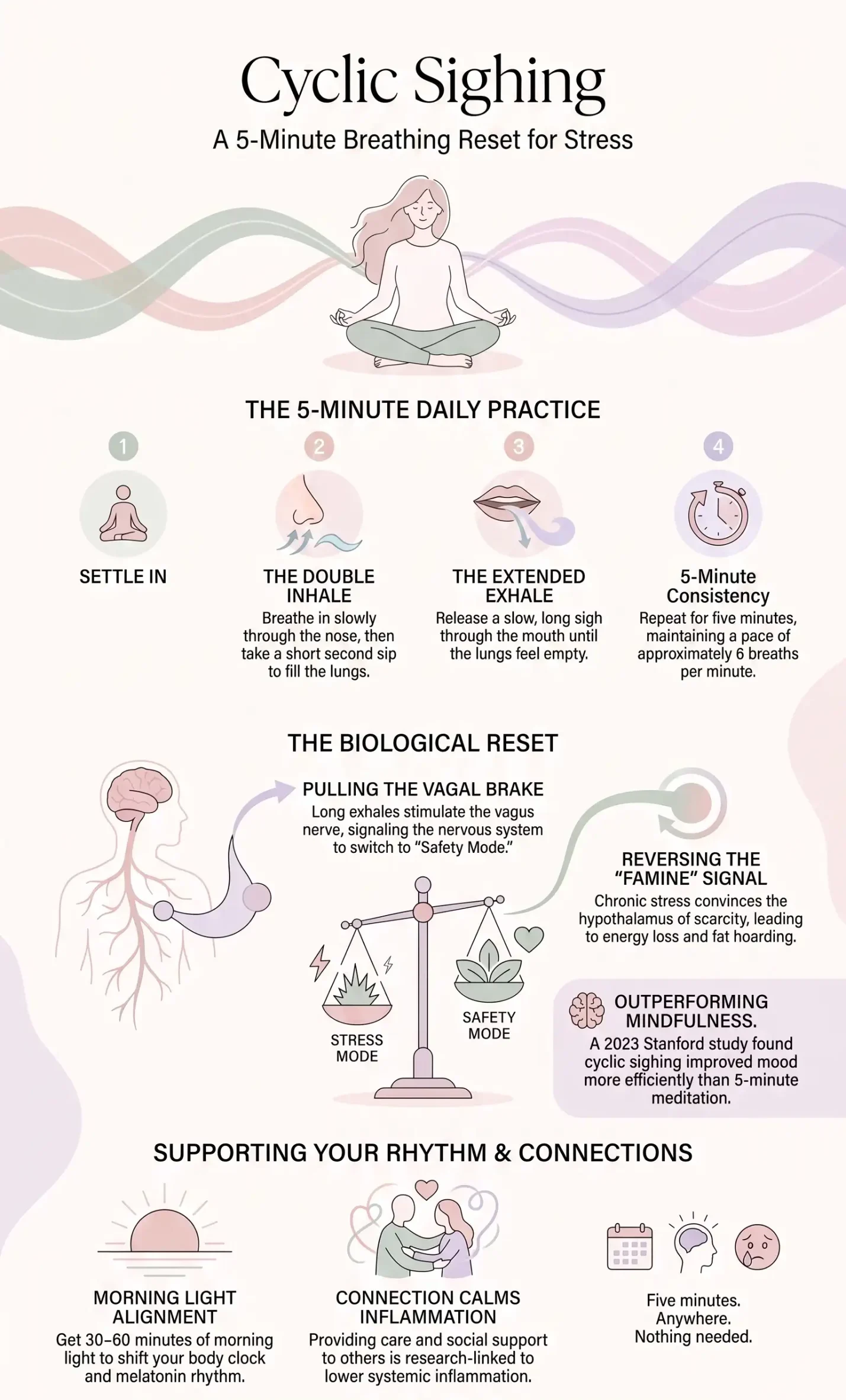
Set a timer for five minutes and sit somewhere comfortable. Air goes in through your nose and out through your mouth for the whole session.
Take a double inhale. Draw a slow breath in through your nose, then, before you let anything out, add one more short sip of air on top to fill your lungs completely. Two inhales, stacked.
Release one long, slow breath through your mouth, and keep going until your lungs feel truly empty. Spend more time on the way out than you did on the way in. Everything hinges on that extended out-breath. Let it carry an audible sigh if you can, which settles the vagus nerve, the nerve responsible for pulling the vagal brake.
Repeat the cycle for the full five minutes at an easy pace, somewhere near six breaths a minute. That double inhale followed by the long exhale is what cyclic sighing means.
That is the whole practice. Once a day. Two inhales, one long exhale, and five minutes you were going to spend scrolling anyway.
Where Does Meditation Still Fit?
Meditation still earns its place. The difference between the two comes down to efficiency rather than value.
A longer sit gives you a longer, deeper stretch of soothing, and some days that is exactly what you want. Cyclic sighing gives you more calm for less time, which is a different kind of useful.
If you are a high-achieving woman, you already know efficiency is everything. When your schedule is tight, when you are about to walk into something hard, or when you wake at three in the morning with your heart racing, five minutes of breathing is what you reach for. Anywhere, with nothing in your hands and nobody watching.
How Does Morning Light Multiply the Habit?
Sleep comes first. Chronic stress costs you more than lost hours, because the pressure also drags your internal clock out of position. In midlife, low mood and broken sleep track closely with a melatonin release that arrives too late in the evening.
Correcting it asks less of you than most sleep advice does. Move your bedtime and your wake time slightly earlier, then get outside for 30 to 60 minutes of morning light within an hour of waking. Nothing resets that internal clock like daylight, and an early dose pulls the whole rhythm forward. Mood tends to follow within a week or two.
Giving support to others comes second, and this one surprises people. Actively caring for someone else may lower your own inflammation. Doing so engages an ancient caregiving system linked to less physiological threat and lower inflammatory markers in the body. The research is early, though it points the same direction as everything else. Connection calms the system.
What Can’t Cyclic Sighing Fix?
This practice is safe for almost everyone, and the evidence that five minutes lowers arousal and lifts mood is solid. It still has limits worth naming out loud.
No amount of breathing erases a stressor that genuinely has to change. An impossible schedule. A relationship that keeps costing you. Work that grinds you down a little more each week. What the practice buys you is a steadier system, which is what you need in order to face the real thing. Facing it remains your part.
If you are managing real anxiety, depression, or a medical condition, keep working with your healthcare professional on the underlying issues alongside this practice. Both matter, and neither replaces the other.
Breathing your way through years of untreated pressure, while whatever caused it keeps festering underneath, amounts to a nicer looking bandage over the same wound. The aim is honesty with your own body. Once safety registers, the hoarding stops and the healing starts.
Can One Small Choice Really Regulate Your Nervous System?
Nervous system regulation sounds like a project that requires a plan, a tracker, and a free weekend. It is closer to a habit, and a very small one.
Try the five minutes tonight, either before bed or the next time your heart starts racing. Then give it a week before you judge it. The shifts tend to be quiet at first. Falling asleep a little faster. Taking a beat before you react to the thing that would normally set you off. Reaching four in the afternoon with your head still clear.
Add morning light the following week and let the two work together. Nervous system regulation happens through repetition rather than intensity, which is good news for anyone who has already tried the intense version and found it unsustainable.
Nothing here asks you to become a different person or find another hour in your day. Five minutes, once, at whatever point feels hardest. Your body has been braced for a very long time, and it will take the first real chance you give it to stand down.
“If you came into my office, I’d ask you a lot of questions that would help us connect the dots … so that together we can deal with your toxic stress.
Every situation is unique and you need a plan that works for you. Not a one-size-fits-all solution.
If you’re thinking you can’t come into my office, don’t worry. I’ve created a program with all of my initial recommendations to help you unravel the mystery. You can use it at home and at your convenience.
So if you’re thinking that managing chronic stress just isn’t possible … or even the answer … for you, I want to show you what you may be missing.
And how you can identify the toxic stressors that are creating your symptoms with my Human Energy System Reboot. You can get started HERE.” – Dr. Gala