
You were tired at 8PM. You were tired again at 9PM. Now it is past 11PM, your head is finally on the pillow, and your brain has decided this is the perfect moment to review the day.
The conversation from this afternoon. The reply you thought of and never said, because saying it would have cost more than swallowing it. An hour goes by. You are still awake, doing arithmetic on how little sleep is left.
Menopause sleep problems get blamed almost entirely on hormones, and hormones are a real part of the story. But the thing keeping you awake often started much earlier, while you were still upright and holding everything together. Those seven to eight hours you keep trimming are the exact window your body uses to rebuild what midlife has been taking apart.
Ask Dr. Gala: Your Wellness Wisdom Starts Here
Does menopause alone explain why I can’t sleep?
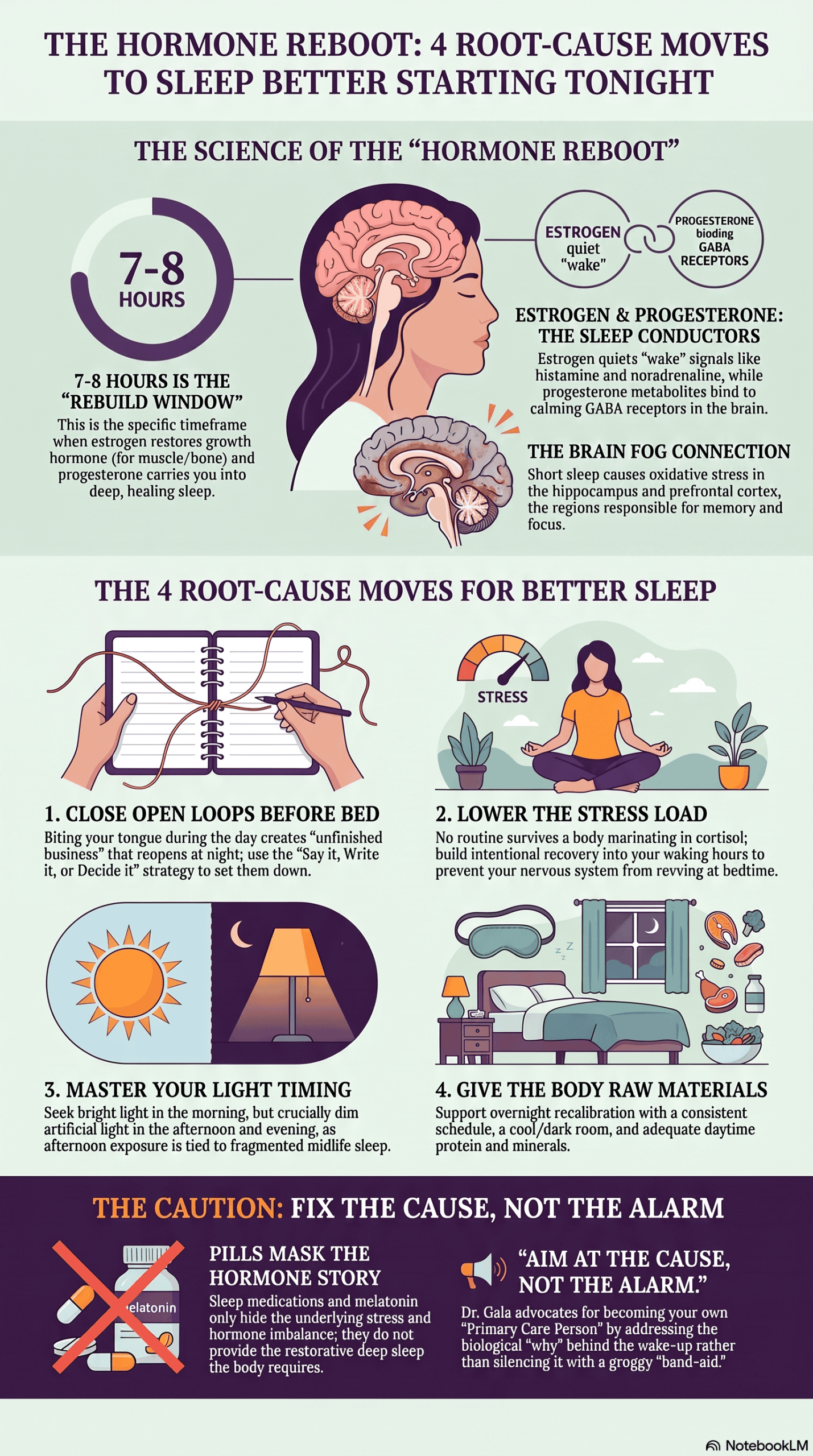
Yes, but hormones are only half of it. Declining estrogen quiets the brain chemicals that keep you alert and awake, and falling progesterone removes a natural sedative that used to carry you into deep sleep. A 2025 review in the Journal of Clinical Medicine on perimenopausal sleep disturbance found this exact pattern, with roughly 80 to 90 percent of women experiencing symptoms during the menopause transition. But the same research points to a second driver running on the same clock. Stress hormones staying high after dark keep your nervous system on alert, so real relief means calming the hormones and the stress load together, not chasing one alone.
Why Do Menopause Sleep Problems Start Long Before Bedtime?
Think about how many small moments you let pass on an ordinary day. The comment you decided was not worth an argument. The favor you agreed to while something in you said no. The correction you held back because the room was already tense.
Each one leaves something unfinished. Your mind files it away as business you still intend to handle, and it stays open, drawing quietly on your attention while you get on with everything else. You do not notice, because there is far too much in front of you to notice anything.
Then the noise stops. The house goes quiet, the lights go off, and for the first time in sixteen hours nothing is competing for your focus. Every unfinished item steps forward at once, because your attention finally has room to hold them.
Nothing about that makes you broken. Your mind is doing work it never got a chance to do earlier.
Which Two Hormones Used to Carry You Into Deep Sleep?

For most of your adult life, two hormones ran your nights without ever asking for credit.
Estrogen was the quieting influence. It softened the signals in your brain whose job is to keep you alert and scanning the room. With estrogen doing its part, those signals dialled down on schedule, and you fell asleep and stayed asleep without giving it a thought.
Progesterone worked even more directly. As your body breaks it down, the compounds it produces settle onto the same calming receptors that anti-anxiety medication targets. Progesterone was, in effect, a sedative your body made on its own and delivered on time.
Perimenopause interrupts both. As those hormones swing and then fall, the system that ran your sleep goes quiet, and nothing arrives to take its place.
There is one more layer. Estrogen also helps your brain respond to melatonin, the hormone that registers darkness. Lower estrogen means a weaker melatonin response, and your internal clock loses the signal it was using to keep time.
This is also why the supplement aisle disappoints so many women. Melatonin comes in a bottle. Estrogen and progesterone do not, and the shortage driving your wakefulness will not be corrected by swallowing something at bedtime.
Why Does Cortisol Keep Your Body on Alert After Dark?
Hormones explain part of menopause sleep problems. Stress explains the rest, and the two are harder to separate than they look.
Cortisol is meant to follow a daily arc. High in the morning to get you moving, tapering through the afternoon, at its lowest by the time you want to sleep. That descent is part of what makes sleep possible at all.
Carry enough stress for long enough and the arc flattens out. Cortisol stays high into the hours when it should be at the floor, and your body reads that as a reason to stay ready. You can be exhausted and wired at the same time, which is one of the strangest experiences midlife hands you.
The relationship between cortisol and sleep runs as a loop rather than a straight line. A poor night raises your stress chemistry the next day. Higher stress chemistry makes the following night harder. A few rough weeks can set a pattern that starts to feel permanent.
Those open loops belong here too. A racing mind at midnight is stress with nowhere left to go.
Why Is Seven to Eight Hours the Number That Matters?
Sleep runs in stages rather than one flat state, and the heaviest repair work happens in the later cycles, after you have already been down for several hours.
Growth hormone shows this clearly. It releases in pulses during your deepest sleep, and it maintains your muscle, your bone density, and a lean body composition. End the night at five hours and you never reach the point where those pulses happen. The hormone was available. You were simply no longer asleep to receive it.
The same timing applies more broadly. Overnight, your body resets growth hormone, prolactin, and cortisol onto their proper schedules for the day ahead. Estrogen normally helps that recalibration finish. When sleep runs short and estrogen is already low, the reset stops partway, and you wake into a day that began with an incomplete setup.
This is why six hours behaves so differently from eight. The hour you lose comes off the end, and the end is where the heaviest work was scheduled.
What Sleep Debt Are Your Brain and Heart Paying?

Short nights do not stay in the night. They accumulate as sleep debt, and the bill arrives in places you would not immediately connect to how you slept.
Start with your brain. Without enough sleep, oxidative stress builds in brain tissue, a slow corrosion that interferes with the connections in the regions handling memory and focus. That is the fog you have been treating as a personal failing. Standing in the kitchen with no idea what you came for. Losing a word halfway through a sentence. Reading the same paragraph three times.
Your heart and metabolism keep their own ledger. Consistently short sleep through the menopause transition raises your risk of weight gain, insulin resistance, and heart disease. The effect has been measured in blood vessels themselves, where poor sleep quality tracks with reduced blood flow and weaker vascular function, which speeds the aging of your whole cardiovascular system.
That is what the link between sleep and longevity actually means. Every short night is a small withdrawal, taken from your hormones, your brain, and your heart at the same time.
Sleep debt is real, and the balance carries forward. The loop also runs in the other direction. A well-slept night predicts more energy and steadier mood the next day, and a steadier mood predicts falling asleep faster the night after. Protect one night and you have made the next one easier.
How Can You Sleep Better Starting Tonight?
Knowing how to sleep better in a body whose chemistry has changed comes down to four moves. None of them requires a new supplement or an expensive gadget.
Close your loops before you lie down. This one goes straight at the racing mind. Say the thing you have been holding. Write it down if tonight is not the night to say it. Decide what you will do about it and give the decision a time. A loop you have named is a loop you can set down.
Bring the whole stress load lower. No bedtime routine survives a body still running on stress chemistry at eleven at night. Because cortisol and sleep move together, real recovery built into your waking hours does more for your nights than any ritual in the last twenty minutes before bed.
Get your light timing right. Plenty of bright light in the morning to anchor your internal clock. Then dim the artificial light through the afternoon and evening rather than waiting for bedtime. Afternoon light exposure has been linked with more broken sleep in midlife women, and almost nobody thinks to adjust anything before dark.
Give your body the raw materials. A consistent sleep and wake time, weekends included. A room that is truly cool and truly dark. Enough protein and enough minerals during the day, because the overnight recalibration has to be built out of something.
Then there is the thing waiting in the medicine cabinet. Sleep medication has its place, and so does melatonin used correctly. What neither one does is address why your sleep came apart. At the wrong dose, at the wrong hour, or taken month after month, they can quiet the signal while the hormone and stress story underneath keeps going. They also tend to leave you dull the next morning without delivering the deep, restorative sleep your body was after.
That is how to sleep better in a way that holds. Four small changes aimed at the cause, rather than one bottle aimed at the alarm.
What Does It Mean to Be Your Own Primary Care Person After Dark?
Some symptoms call for a professional rather than a better bedtime routine. If you are soaked through with night sweats, if you wake gasping for air, or if your mood has taken a serious turn, book the appointment. Persistent insomnia, sleep apnea, and significant anxiety or depression are common in midlife, they respond well to treatment, and none of them should be worked out alone at two in the morning.
Calling someone in is part of the role. The Primary Care Person in your life is whoever notices the pattern, asks the sharper question, and decides what happens next. Some nights that means dimming the lights an hour earlier. Some seasons it means picking up the phone.
What changes everything is the shift from enduring your nights to reading them. A wakeful hour stops being a verdict on your character and starts being information about what your body handled that day and never got to put down.
Menopause sleep problems respond to being understood rather than overpowered. Close the loops you have been carrying since morning. Lower the stress your body has been holding all day. Protect the hours where the repair actually happens, and let your body finish the work it has been trying to do every single night since this began.
“If you came into my office, I’d ask you a lot of questions that would help us connect the dots … so that together we can deal with your toxic stress.
Every situation is unique and you need a plan that works for you. Not a one-size-fits-all solution.
If you’re thinking you can’t come into my office, don’t worry. I’ve created a program with all of my initial recommendations to help you unravel the mystery. You can use it at home and at your convenience.
So if you’re thinking that managing chronic stress just isn’t possible … or even the answer … for you, I want to show you what you may be missing.
And how you can identify the toxic stressors that are creating your symptoms with my Human Energy System Reboot. You can get started HERE.” – Dr. Gala