
You eat well. You keep moving. You get to bed at a decent hour, and you still wake up feeling like you gave back a little more ground than you gained.
That gap has an explanation, and healthy aging after 60 has far less to do with effort than anyone admits. Two messages your body once received without any trouble have gone faint. One tells your muscles to rebuild themselves. The other tells your internal clock when the day starts and when it ends. Both used to arrive on their own. Neither one does now, and the new rules were never handed to you in writing.
Raise the volume on those two signals and most of what feels like decline starts to look like something you can answer.
Ask Dr. Gala: Your Wellness Wisdom Starts Here
Do your muscles really stop responding to protein the way they once did?
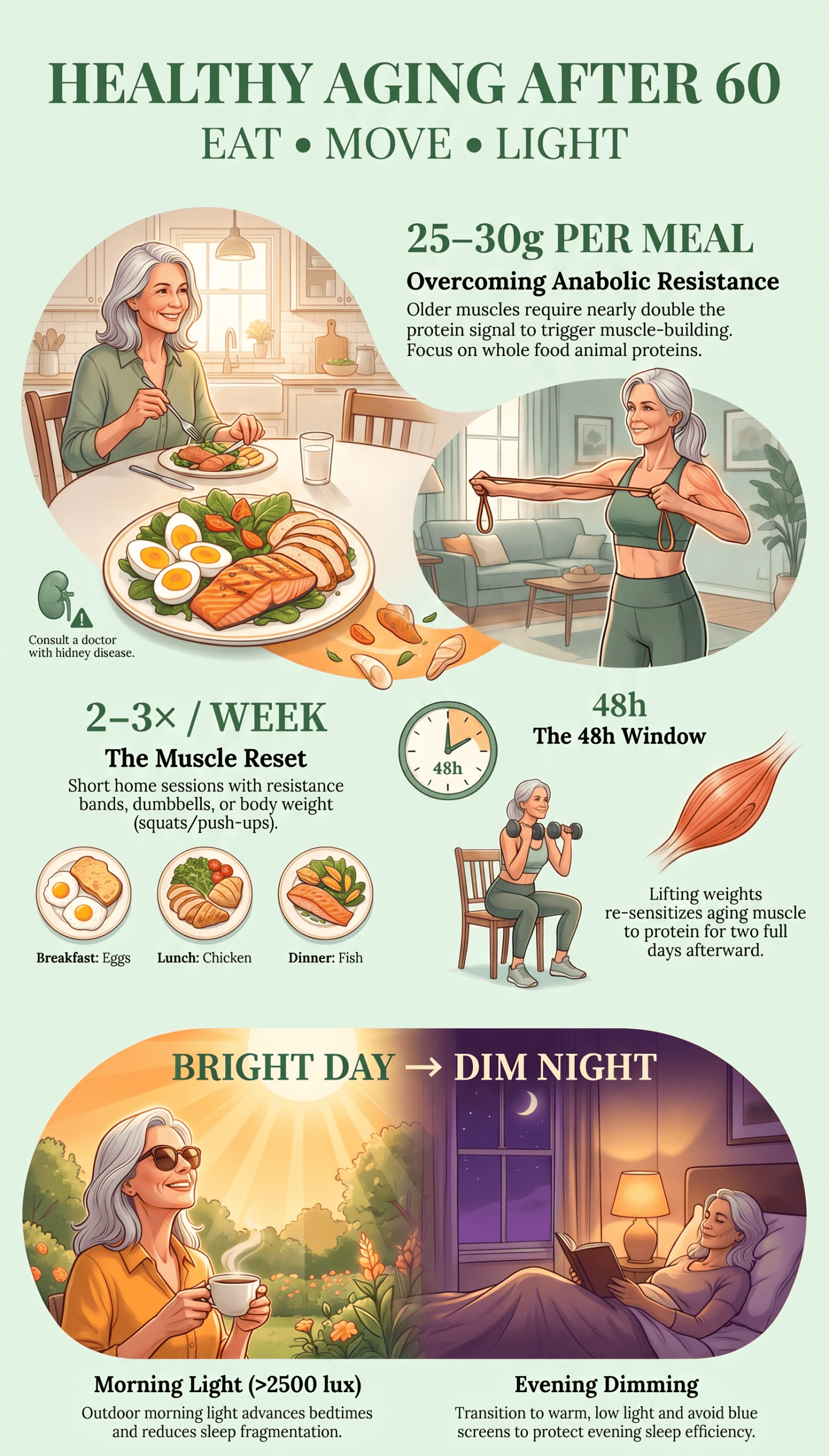
Yes, and the shortfall has a name. Anabolic resistance means a serving that once told your muscles to rebuild no longer registers, so the same instruction has to arrive far louder before anything acts on it. That is the part of healthy aging after 60 that effort alone will never solve. Aim for 25 to 30 grams of quality protein at every meal instead of saving it all for dinner, and add something with real resistance in it twice a week. One session leaves your muscle better at using protein for another 48 hours, which is why food and lifting only work as a pair.
What Is Anabolic Resistance and Why Does It Start After 60?
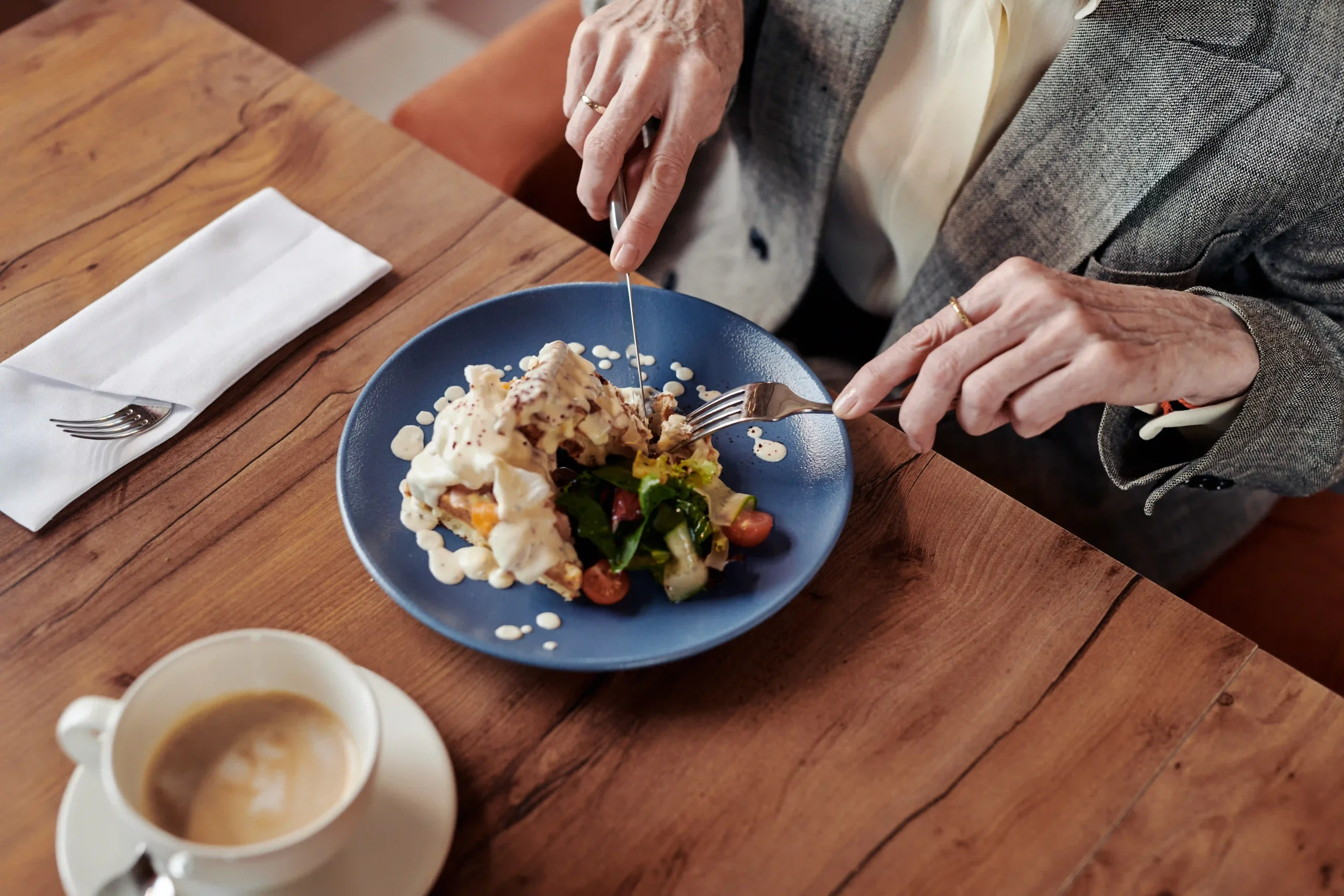
You were raised on subtraction. Eat less. Take the smaller plate. Skip the second helping and count what sits on the first one.
That advice ages badly. Somewhere past menopause, your body develops anabolic resistance, and the name describes the trouble well. A modest serving of protein used to be plenty to tell your muscles to rebuild. That same message now has to shout before anything hears it. Your muscle has gone partly deaf.
None of this is a personal failing, and none of it is permanent. The muscle is still there. What faded is its ability to catch the instruction, and hearing can come back.
What sits at stake here is not how you look in a photograph. The muscle that slips away in your sixties is the muscle that keeps you steady stepping off a curb, strong enough to carry a grandchild across a room, and living in your own house on your own terms. Menopause muscle loss has been studied long enough to produce specific numbers, and specific numbers are something you can act on.
How High Does Your Protein Intake Need to Go After 60?
Start with the number that matters. To cross the threshold that restarts muscle building in a body past 60, plan on roughly 0.2 grams for every pound of body weight, at every single meal. At 150 pounds, that lands on 30 grams. Call it 25 to 30 grams of quality protein per sitting, and treat it as a floor rather than a target.
Across a full day, the total comes to somewhere between half a gram and three-quarters of a gram per pound. For that same 150-pound woman, roughly 75 to 100 grams daily. Most women reading this are nowhere near it.
The habit itself is small. Put your protein first, ahead of everything else on the plate, and confirm you actually hit 25 to 30 grams instead of assuming you did. Lean animal protein gets you there fastest. Turkey, chicken, fish. Eggs are wonderful food and poor arithmetic, since each one carries only six or seven grams, and two eggs is where most appetites quit.
Spreading your protein intake through the day counts as much as the daily total. Hold it all for dinner and your muscles hear nothing through breakfast and lunch, then receive more at once than one sitting can put to use. If you eat two meals rather than three, there is no room for a light one.
One caution before you change anything. If you live with kidney disease, or suspect any trouble there, hold off on increasing your protein intake until you have talked it through with the practitioner who already knows your case. For most women these amounts are ordinary and safe, though ordinary is not the same thing as universal.
What Does Resistance Training Actually Do for Aging Muscle?
Better eating solves half the problem. If the message still cannot get through, most of that extra food goes unheard.
This is where resistance training stops being optional. Making your muscles work against resistance goes around the faulty signaling completely. It restarts the exact muscle-building pathway that had fallen silent, and it leaves your muscle freshly sensitive to protein for up to 48 hours afterward.
That last sentence deserves a second read. A single session leaves your body better at using protein for the next two days. Food and lifting are a single mechanism with two halves, and neither half does much on its own.
None of this requires a gym, a barbell, or anything that intimidates you. Resistance means a band looped around a doorknob, two dumbbells parked beside the sofa, a kettlebell, or your own body in a squat, a wall push-up, or a slow yoga sequence. Pilates counts. Two or three short sessions across the week will change the direction you are heading.
If lifting is new to you, start light and book a session with someone who can watch your form. An injury costs you more ground than slow progress ever will. Age is not the barrier here. The signal is, and you are the one who gets to send it.
Are Your Days Too Dim for Your Body to Read Them?
The second faded signal has nothing to do with food. Most people past 60 spend their waking hours in light so weak that the body files it as an extended dusk. Indoor lighting looks bright to your eyes and registers as almost nothing to your internal clock. That clock never collects a strong enough daytime cue to work out when night should begin, so it drifts later, and your bedtime drifts with it.
Recent work with healthy older adults tested what happens when the cue is restored. Give people genuine daytime brightness, above 2,500 lux, which in practice means outdoors, and their bedtime moved earlier without any effort on their part. Their rest and activity rhythm steadied. Broken, fragmented nights fell away.
So the habit is almost embarrassingly plain. Get outside in the morning, get outside again later, and aim for a couple of hours of real daylight across the day. Coffee on the porch instead of the kitchen table. A walk before the morning gets away from you. A chair pulled over to the brightest window in the house. It costs nothing and outperforms most of what people buy to fix their sleep.
Then comes the other half, because the two only work as a pair. Evening exposure to bright, blue-heavy light, meaning your overhead fixtures, your television, your phone, your tablet, stretches out how long it takes you to fall asleep and drags down the quality of whatever sleep you finally get. Your body reads that glare as more daytime and postpones the entire wind-down.
For the last hour or two before bed, bring it down. Kill the overhead lights and switch to a lamp with a soft bulb. Put the screens away, or at minimum dim them. Call it fussy if you like. What you are doing is supplying a cue your aging clock can no longer produce by itself. Bright days. Dim evenings. Your sleep rhythm runs on the difference between the two.
Which Supplement Actually Earns Its Place on Your Shelf?
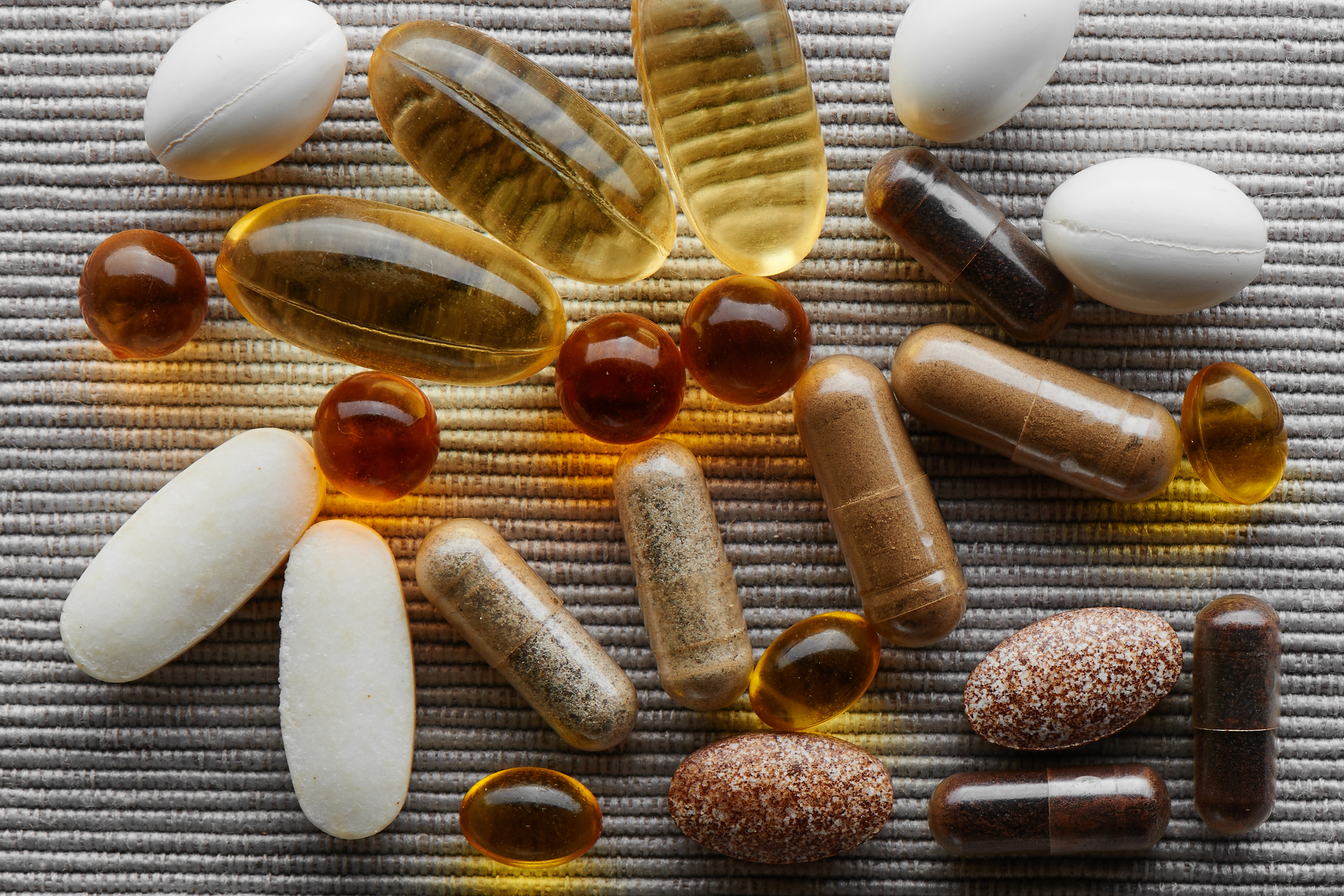
Somebody always asks about supplements, and there is one here with real evidence underneath it.
Creatine carries a reputation problem. It sounds like something for twenty-year-old men in a weight room, and that reputation has kept it away from the women most likely to benefit. In older adults, a daily dose of creatine monohydrate raises the stores of quick energy your muscles can pull from during higher intensity effort, and it appears to add to whatever you are already getting from resistance training.
The evidence is promising rather than settled, so file it under worth considering rather than essential. Even so, among all the powders and pills marketed to women in this stage of life, creatine belongs to a very short list with genuine science behind it, and it sits naturally alongside the eating and lifting you are already doing.
Stay cautious anyway, particularly if you take medication. Any supplement can interact with something already in your system, and this one is no exception.
Is Menopause Muscle Loss Really Just About Hormones?
Every habit on this page works better or worse depending on one variable that almost never makes the list, and that variable is your stress load.
Conversations about menopause muscle loss tend to stop at hormones, as though the hormonal shift were the whole account and everything else were footnotes. Chronic stress and broken sleep sit underneath all of it and decide how much any single habit gives back to you. Stack a supplement on top of an unaddressed stress load and you have a better-looking bandage over the same wound.
The point was never to decorate the problem.
Which is also why the worst move available to you this week is attempting all of it at once. Choking down a protein powder you cannot stand, lifting heavy with sloppy form, and loading up on capsules by Sunday is how people get hurt, quit, or trade one problem for a different one. Choose a single habit. Let it become automatic. Then add the next.
And if you are managing a diagnosed condition, loop in the practitioner who knows your case before you change anything that matters.
Healthy Aging Asks You to Become Your Own Primary Care Person
Becoming your own Primary Care Person is quieter than it sounds. It means noticing which messages your body has stopped picking up on its own, then sending them deliberately. Protein at the front of the plate. Something with resistance in it, twice a week. Morning light on your face, and a dark hour before bed. Four small acts, repeated until they stop needing a decision.
Effort was never your shortage. Healthy aging turns on aim instead, pointing the work you already do at the two signals that went quiet rather than at whatever the wellness internet is selling this month. Choose one. The protein, the lifting, or the light. Give it a few weeks and let your body report back.
The message was there the whole time. Your body was only waiting for a way to be heard
“If you came into my office, I’d ask you a lot of questions that would help us connect the dots … so that together we can deal with your toxic stress.
Every situation is unique and you need a plan that works for you. Not a one-size-fits-all solution.
If you’re thinking you can’t come into my office, don’t worry. I’ve created a program with all of my initial recommendations to help you unravel the mystery. You can use it at home and at your convenience.
So if you’re thinking that managing chronic stress just isn’t possible … or even the answer … for you, I want to show you what you may be missing.
And how you can identify the toxic stressors that are creating your symptoms with my Human Energy System Reboot. You can get started HERE.” – Dr. Gala