
You used to be the one who could handle anything. The job, the family, the crisis at 2 a.m., all of it managed without missing a beat. Now you stand in your own kitchen with a short list of simple tasks, and you can’t make yourself begin. So you reorganize a drawer instead, or you simply freeze in place and then quietly scold yourself for it.
Here is what almost no one explains. That stall isn’t laziness, and it’s not a broken will. It’s an amygdala hijack, a small alarm system in your brain stuck in the on position after years of pressure.
The term itself isn’t a wellness buzzword. Psychologist Daniel Goleman coined “amygdala hijack” in his 1995 book Emotional Intelligence, to describe exactly this: the emotional brain overriding the rational brain before you’ve had a chance to think it through. He was writing about outbursts, the things people say and regret. The freeze you feel standing in your own kitchen is the same hijack, just running slower and staying longer.
Your body hasn’t turned on you. It’s running an old survival program, and that program can be switched back off.
Ask Dr. Gala: Your Wellness Wisdom Starts Here
Is freezing at simple tasks actually happening in my brain, not a failure of willpower?
Yes. Neuroscientist Bruce McEwen’s research on chronic stress found the amygdala, the brain’s alarm center, grows more reactive branches under sustained pressure, while the prefrontal cortex, the region that handles focus and decisions, loses branching under the same conditions. The alarm fires first and the thinking part arrives late, which is how a capable woman stalls on something she has done a thousand times. That is an amygdala hijack, a term psychologist Daniel Goleman coined in his 1995 book Emotional Intelligence, and willpower is the wrong tool for it. The way out is signaling safety to your body, over and over, until the alarm stops leading.
Why Does an Amygdala Hijack Feel Like Losing Your Edge?

Somewhere deep in your brain sits a small, almond-shaped structure whose entire job is to watch for danger. The instant it senses a threat, it slams the brakes on your thinking brain and throws you straight into fight, flight, or freeze. When a car swerves into your lane, this is a magnificent piece of biology. It moves faster than thought, and it saves your life.
There’s a reason this lands so hard for women specifically, right now. A 2019 study out of the University of Regina, led by psychologist Jennifer Gordon and published in Frontiers in Psychology, found that women moving through the menopause transition had a stronger stress and mood response on the days their estradiol was swinging most. The hormone shifts of perimenopause don’t stop at hot flashes and sleep. They turn up the volume on an alarm system already worn down by years of pressure, which is exactly why the freeze can show up now, at this age, for a woman who never used to stall on anything.
The trouble is that this alarm can’t tell a swerving car apart from twenty years of deadlines, caretaking, and quiet financial worry. To the older part of your brain, chronic stress reads as a danger that simply never lets up. So a system meant to fire for a few seconds ends up switched on for years. That’s the amygdala hijack, and it explains why the smallest task can suddenly feel like far too much to face.
You can watch it play out in the small avoidances. You tidy a drawer that didn’t need tidying and tell yourself it counts as progress. You lose another half hour to your phone. Clearing clutter is a fine thing on its own, yet when it becomes a way to dodge what actually matters, it’s worth asking what the tidying is quietly protecting you from.
Why Is the Freeze Response Written Into Your Biology?
Stay under that kind of pressure long enough, and the physical shape of your brain begins to shift. A steady flood of stress hormones makes the alarm center grow larger and quicker to fire. At the same time, the prefrontal cortex, the calm executive that handles focus, planning, and steady decisions, grows weaker and loses some of its wiring.
This isn’t guesswork. Neuroscientist Bruce McEwen spent decades at Rockefeller University studying exactly this trade-off, and his research is where this picture comes from: under sustained stress, neurons in the amygdala grow new branches and fire more easily, while neurons in the prefrontal cortex lose branches and shrink back. Two regions, one stressor, opposite outcomes. That’s the mechanism behind the fog. It isn’t a flaw in you.
This is where it starts to make sense. The alarm gets louder while the capable, level-headed part of you goes quiet. That imbalance is the freeze response. It’s the fog that settles over your afternoon. It’s the reason a sharp, accomplished woman can stand three feet from a sink of dishes and feel unable to start. None of this is a character flaw. A weaker will isn’t what changed here. The wiring did.
There’s real hope folded into this. The way your brain answers a single stressful moment tends to set the tone for how stressed you feel in the weeks and months that follow. Your reaction isn’t random. It’s a pattern your nervous system has learned and keeps repeating. And a pattern that was learned can be taught again a gentler way. If the freeze was built over time, it can be rebuilt. If the alarm learned to shout, it can learn to settle.
How Can You Get Out of Survival Mode, One Signal at a Time?
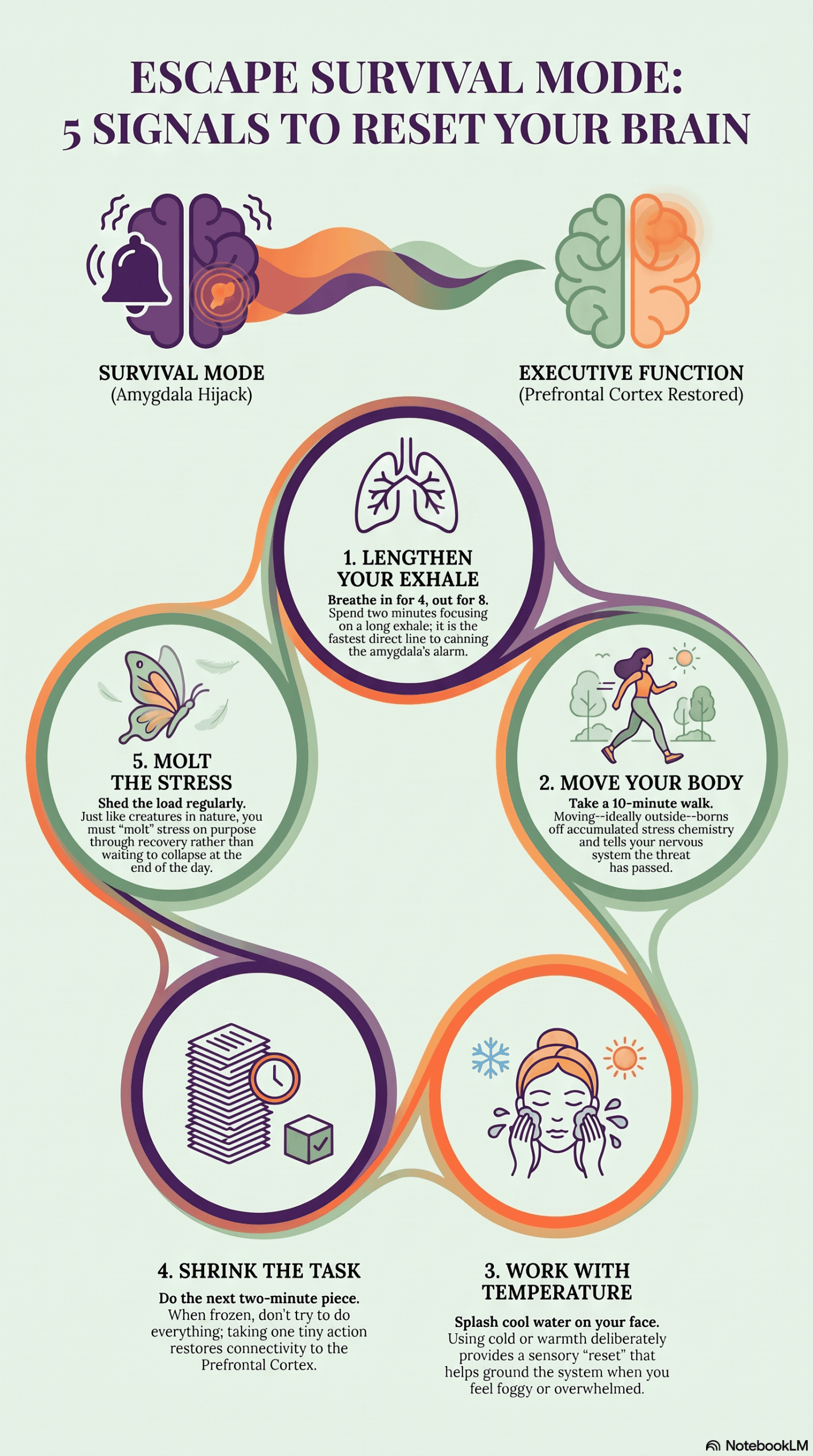
Learning how to get out of survival mode starts with one plain fact. You do not outthink an amygdala. The moment you try to reason with a hijacked brain, you reach for the very part that stress has benched, so logic arrives too late to help. What still works is your body, because the alarm listens to physical signals far more closely than to arguments. The way through is to keep sending one steady message: you’re safe now. Five small moves do exactly that, and none of them asks for willpower you don’t currently have.
Lengthen your exhale. Breathe in for a count of four and out for a count of eight, and hold that rhythm for two full minutes. A long, slow exhale is the quickest direct line to a calmer alarm, because it tells your nervous system in its own language that the emergency has ended.
Move your body. A ten-minute walk, ideally outdoors, burns off the stress chemistry already circulating and shows your nervous system that the threat has passed. Motion is a signal all its own.
Work with temperature. A splash of cool water on your face nudges the whole system to reset, gently and almost at once. It’s a small physical jolt that interrupts the loop.
Shrink the task. Frozen isn’t the moment to tackle everything on the list. It’s the moment to do the next two-minute piece and nothing more. That small action wakes the prefrontal cortex and coaxes it back online, and momentum grows from there.
MOLT the stress. In nature, creatures shed what they have outgrown, and your stress deserves the same fate. An approach called the MOLT Method builds recovery around four levers, mindset, order, lifestyle, and toxins, so that shedding stress becomes a steady habit rather than a rare collapse at the end of a punishing day.
Stacked together, these moves are less a routine to perfect and more a language you’re relearning, the language of safety your body already knows how to speak.
What Coffee Trap Feeds the Alarm?

When the fog rolls in, the instinct is to force a way through it. One more coffee. Something sweet for a fast lift. A grim promise to power on through sheer grit. It all feels productive, and it quietly makes the whole thing worse.
Caffeine and sugar light up the same stress chemistry that’s already holding your alarm wide open. You end up pouring fuel on a fire you’re trying to put out, which is why the push so often leaves you more wired, more scattered, and more drained by mid-afternoon than when you began. By the time the crash lands, you’re running on fumes and calling it a personal failing. The fast fix that promises relief is usually what deepens the amygdala hijack.
A shelf of supplements isn’t the rescue either. Real relief comes from lifting the toxic stress load at its root, so your brain is finally free to do the work it does best.
Start smaller than feels reasonable. Two minutes at the sink. One email, not the whole inbox. Set a timer if you need proof it will end. A brain running the alarm can’t take in a whole afternoon, but it can handle 120 seconds, and finishing something tiny is the evidence it has been waiting for. Do that three times today and you’ve told your body the truth … you’re safe enough to move.
How Do You Teach the Alarm to Stand Down?

None of this is a life sentence. The freeze response took shape through repetition, one stressful season stacked on the next, and it eases the same way, through repetition of a very different kind. Every slow exhale, every short walk, every two-minute task you finish is another small message to your body that the danger has passed.
Send that message often enough, and the alarm finally begins to quiet. The fog thins. The capable woman who seemed to disappear was never actually gone. She was waiting behind a nervous system that needed to feel safe again. Give it that safety, steadily and on purpose, and your focus, your steadiness, and your clear thinking come back online, right where you left them.
Progress here is rarely loud. It looks like starting the dishes without the long stall beforehand. It looks like an afternoon that doesn’t dissolve into fog. Small wins, stacked patiently, are how a tired nervous system finally learns that the emergency is over.
“If you came into my office, I’d ask you a lot of questions that would help us connect the dots … so that together we can deal with your toxic stress.
Every situation is unique and you need a plan that works for you. Not a one-size-fits-all solution.
If you’re thinking you can’t come into my office, don’t worry. I’ve created a program with all of my initial recommendations to help you unravel the mystery. You can use it at home and at your convenience.
So if you’re thinking that managing chronic stress just isn’t possible … or even the answer … for you, I want to show you what you may be missing.
And how you can identify the toxic stressors that are creating your symptoms with my Human Energy System Reboot. You can get started HERE.” – Dr. Gala