

You have been marching. Arms pumping, pace pushed, steps logged before most people are awake. And the midsection you are working so hard on has not moved.
Nobody explained this piece to you. The scorecard inside you was never measuring how hard you worked. It measures how much you moved, added up across the whole day. That single distinction reshapes visceral fat loss after menopause, and it explains why the harder approach has been working against you.
Your body has been answering the signals you send it, exactly as built. Those signals can start changing on your very next walk.
Ask Dr. Gala: Your Wellness Wisdom Starts Here
Can walking still shift your belly in midlife when harder workouts have not?
Yes, and the part that matters is how long you move rather than how fast. Total movement across the whole day is what drives visceral fat loss, and one hard session cannot buy back a still afternoon. Pushing the pace spikes cortisol, and cortisol is exactly what tells your midsection to hold on, so the punishing workout can work against the result you are training for. Gentler walking sidesteps that, and it is far easier to keep going when your energy is already thin. An ordinary hour spread through an ordinary day, repeated, beats three sessions a week you dread and abandon.
Why Does Visceral Fat Loss Stall When You Push the Pace Too Hard?

Think about the advice you have absorbed for decades. Go harder. Push the heart rate up. Feel the burn. Most guidance on walking for weight loss still runs on that engine, and for a woman in midlife it can point in exactly the wrong direction. The advice was built around bodies that recover quickly and hormones that hold steady, which describes almost nobody past 45.
Effort and results are not the same currency. When you go to war with your body, when you punish it in the name of discipline, your stress hormones climb. Those hormones carry a very specific instruction, and that instruction is to store fat around your middle and keep a firm grip on it. The harder you grind, the clearer the message gets.
What your system actually responds to sits somewhere else entirely. Researchers who study this measure the total amount of movement, meaning how long you stay in motion at a given effort. That total turns out to matter far more than the ferocity you bring to any single session.
Your effort was never wasted. It was simply being measured against the wrong meter. Speed and sweat feel like progress because they are easy to count, while quiet time on your feet slips by unrecorded.
What Does Menopause Belly Fat Turn Into After Your Ovaries Wind Down?
The fat around your middle behaves differently from the fat on your arms or thighs. Visceral fat sits deep, wrapped around your organs, and after menopause it stops being quiet storage.
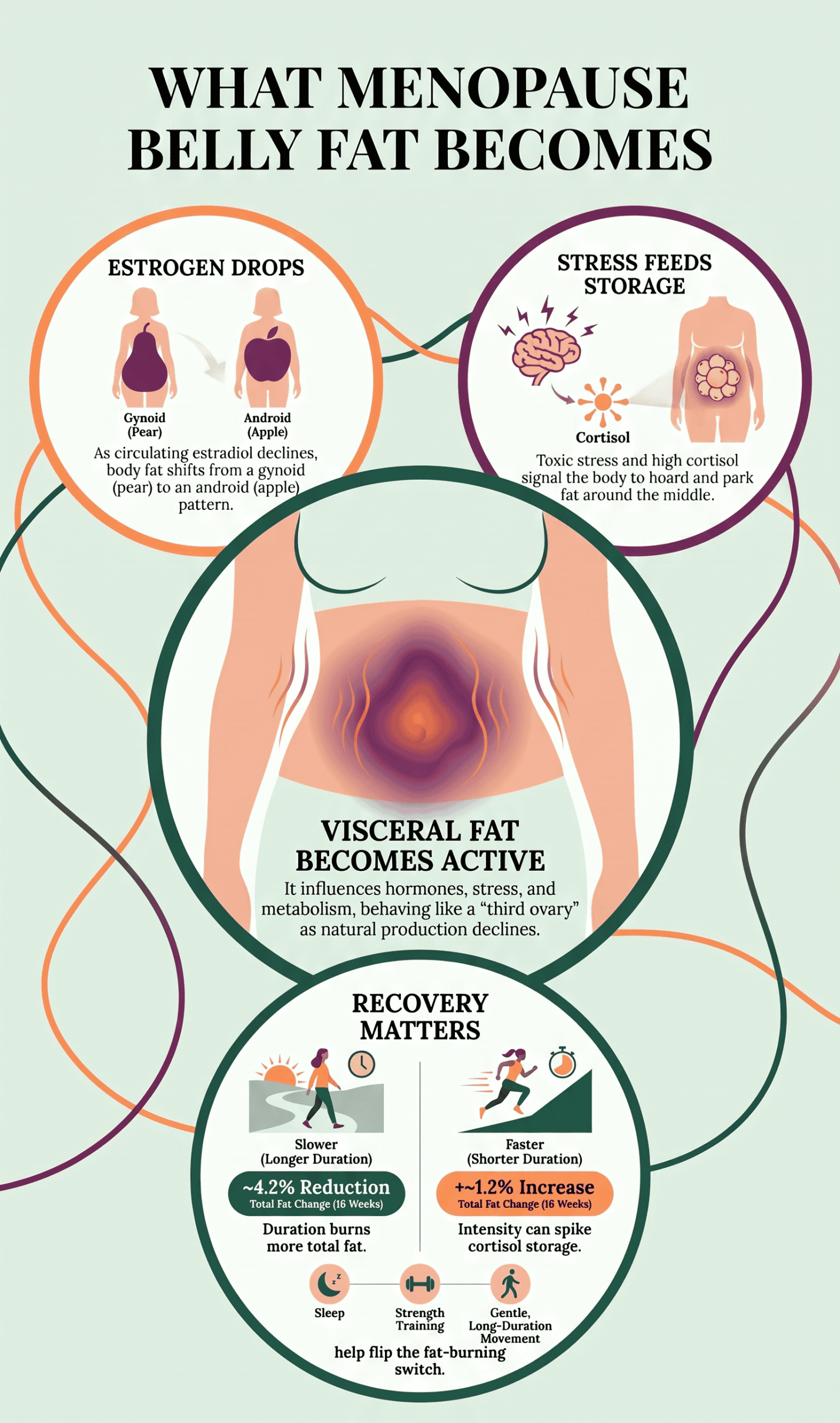
It becomes hormonally active tissue. It produces hormones of its own, stepping into a role your ovaries have been winding down from. Some people describe it as a third ovary, which sounds dramatic until you sit with what it means in practice. You now have a hormone-producing midsection that takes its cues from your stress chemistry.
That is the loop worth seeing clearly. Stress feeds the fat. The fat then feeds the hormonal disorder that made your midsection a target in the first place. This is where willpower stops being the useful question. Your stress load is the lever that actually moves, and menopause belly fat responds to how you treat yourself across the whole day rather than to how ferociously you attack one workout.
That shift also explains why the same routine you ran in your thirties stopped delivering. The tissue itself changed roles. What used to sit there as inert padding now takes part in the conversation, and it listens closely to whatever your stress chemistry is saying. Cortisol and belly fat end up working the same shift at precisely the stage of life when you have the least patience for it.
How Do Cortisol and Belly Fat Keep Each Other in Business?
The link between cortisol and belly fat stops being subtle once you know where to look. Cortisol rises under strain of any kind, physical or emotional, and one of its jobs is to make sure reserves are banked for the emergency it believes is coming. Abdominal storage is how it builds that reserve.
Midlife stacks the deck further. Estrogen drops. Muscle mass thins out. Sleep gets lighter and shorter. Each of those raises the odds that fat gathers around your middle rather than anywhere else, which is a large part of why menopause belly fat feels so much harder to shift after 50 than it ever did before.
Now add a punishing workout to a body already running close to empty. You have handed it one more stressor to manage, and it answers the only way it knows how. If your movement leaves you more depleted than when you started, treat that as information rather than as proof you need to try harder.
None of this makes cortisol the enemy. It does necessary work, and a system without it would leave you defenseless in a real emergency. The trouble begins when the strain never lets up, so the hormone never stands down. Cortisol and belly fat stay locked together in that state, and gentler movement is one of the few things that interrupts the pattern without adding more fuel to it.
What Did the Research Find About Total Movement?
The study behind this is La New and Borer’s “Effects of Walking Speed on Total and Regional Body Fat in Healthy Postmenopausal Women”, published in the journal Nutrients in 2022. Two groups of postmenopausal women walked the same 4.8-kilometer distance, four days a week: one at a brisk pace, one at a gentler pace that simply took longer to cover the same ground. By thirty weeks, waist measurements had dropped in both groups by roughly the same amount, which is the evidence that your midsection answers to how much you moved, not how fast you moved it.
Over thirty weeks, the gentler group lost total body fat steadily, around four percent by the halfway mark and roughly seven and a half percent by the end. The faster group gained slightly at first and only began losing after the full thirty weeks had passed.
The finding about your midsection deserves precision, because it is the one most often garbled in the retelling. Waist measurements came down in both groups. The researchers concluded that visceral fat answers to the amount of energy you spend rather than the speed at which you spend it. Total movement is what does the work.
One more detail belongs here. The gentler group started out carrying more body fat, and the researchers flagged that as a reason the comparison leaned their way. The practical lesson survives it. Time on your feet counts for more than the pace you set, and that holds whichever end of the range you are starting from.
How Can Walking for Weight Loss Fit the Day You Already Have?
None of this asks you to find ninety spare minutes or buy a single thing. It asks you to spread movement across the hours you already have.
A treadmill desk can turn a working day into five miles at a conversational pace, somewhere near two miles an hour, without ever feeling like exercise. An easy walk after dinner adds another stretch of it. Pacing while you are on a call adds more. None of it sounds the stress alarm, which is the entire point.
Start where your day already has gaps. Ten minutes after breakfast, fifteen after lunch, twenty after dinner. Those add up to three quarters of an hour without a single block of time carved out of anything you were already doing. The total is what counts, and nothing in you registers that you split it into pieces.
Set that against twenty hard minutes that leave you wrung out and reaching for the couch. The gentler version accumulates. The punishing version charges you something you then have to recover from before you can do it again.
Sustainability is the quiet variable in all of this. Whatever you can keep doing four days a week for thirty weeks will always outperform the routine you abandon in three.
What Does It Mean to Be Your Own Primary Care Person Here?
Strength training still matters in midlife, but the goal is progress you can recover from. If your waist changes quickly or belly fat keeps increasing, ask for medical testing to rule out thyroid, insulin, or hormonal issues.
Being your own Primary Care Person means listening to your body and knowing when to seek help. Visceral fat loss responds best to steady movement, manageable effort, and consistent walking.
“If you came into my office, I’d ask you a lot of questions that would help us connect the dots … so that together we can deal with your toxic stress.
Every situation is unique and you need a plan that works for you. Not a one-size-fits-all solution.
If you’re thinking you can’t come into my office, don’t worry. I’ve created a program with all of my initial recommendations to help you unravel the mystery. You can use it at home and at your convenience.
So if you’re thinking that managing chronic stress just isn’t possible … or even the answer … for you, I want to show you what you may be missing.
And how you can identify the toxic stressors that are creating your symptoms with my Human Energy System Reboot. You can get started HERE.” – Dr. Gala